

Optics for X Ray Fluorescence Spectrometry - WDXRF


Dispersive X-Ray Fluorescence Spectrometry (WDXRF)
Wavelength Dispersive X-Ray Fluorescence Spectrometry (WDXRF) is a non-destructive analytical technique used to determine the elemental composition of various materials. This method relies on X-ray fluorescence, a physical phenomenon where a material emits characteristic X-rays when excited by a primary X-ray beam.
Principles of Operation
Sample Excitation
A sample is irradiated with an X-ray beam from an X-ray tube.
The incident X-ray photons eject electrons from the inner shells of the sample's atoms, creating electronic vacancies.
Electrons from outer shells fill these vacancies, emitting secondary X-ray photons characteristic of each element present in the sample.
X-Ray Dispersion
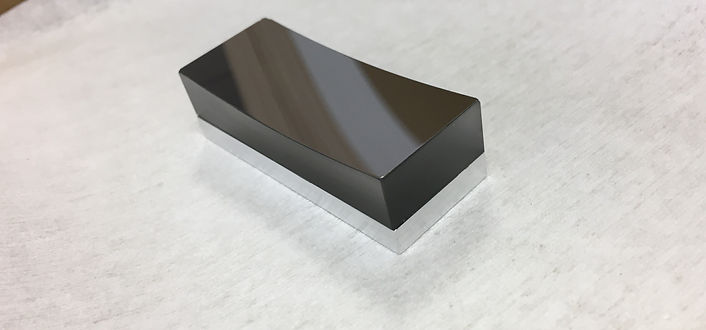
The X-ray photons emitted by the sample are dispersed according to their wavelength using an analyzer crystal.
The crystal diffracts the X-rays at the Bragg angle, allowing the separation of different wavelengths.
Need for Monochromator Crystals
Monochromator crystals are essential in WDXRF to select a specific wavelength of the X-rays emitted by the sample. They act as filters that only allow X-rays of a certain energy to pass through, thereby enhancing the resolution and precision of the analysis. Without these crystals, the signals from different elements would overlap, making the analysis much more challenging.
Detection and Analysis
The dispersed X-rays are detected by a detection system that measures the intensity of X-rays at different wavelengths.
The data is then analyzed to determine the concentration of elements present in the sample.
